Excerpted with commentary from: Range-of-Motion
Testing charts by Richard Finn and C. M. Shifflett. See examples of
shoulder and rotator cuff pain that
these tests help evaluate. See also our sampler of cervical tests
from the charts and typical neck and head
pain patterns coming from muscles and fascia. Get all the tests on 2 wallcharts for office or dojo.
Order here while
they're still on sale!
|
Rotator Cuff and Shoulder Girdle Tests
The following examples of muscle testing
reveal muscle problems that may underlie rotator cuff or shoulder girdle
pain and dysfunction. Always always get the appropriate medical
attention and tests. An MRI is best for rotator cuff tears. Sonograms
are reliable for detecting major tears (but not small ones).
Travell & Simons (1999) pointed out that . . . "Painfully restricted motion
at the shoulder ("frozen shoulder") that is due to adhesive capsulitis
exhibits less pain and more rigidity than does comparable
restriction that is caused by myofascial TrPs [trigger points]. True
adhesive capsulitis often requires short-term steroid therapy, which
may be given orally. However . . . Multiple TrPs in the rotator cuff muscles,
especially in the subscapularis muscle,
can mimic the symptoms of adhesive capsulitis. When a patient has not responded well to
treatment for the diagnosis of adhesive capsulities, the clinician
needs to consider TrP sources for the patient's symptoms.
When TrPs are producing the symptoms, appropriate TrP therapy (without steroids)
should be initiated. It is not unusual for both conditions to coexist.
Both need treatment."
Travell, J. G. and Simons, D. G. (1999),Myofascial Pain and Dysfunction--
The Trigger Point Manual, p. 488. See also their extensive section on
differential diagnosis of shoulder and rotator cuff problems starting
on p. 544. Available from www.lww.com
|
|
Mouth
Wraparound Test
Infraspinatus DBAL Middle Deltoid
SBAL Subscapularis DBAL Posterior Deltoid
SBAL Supraspinatus
Teres Major SFAL Latissimus
Dorsi SFAL/BFL Levator Scapula DBAL Splenius Cervicis
SL Teres Minor DBAL Coracobrachialis
|
This is the single most important
test for shoulder girdle dysfunction. Combine with Backrub
Test , below.
- Position patient’s head at 45o to shoulders.
- Patient reaches arm around back of head to mouth.
Substitution: Increasing head angle to reach
hand. Maintain proper posture.
A. No restriction: Short upper
arms should reach corner of mouth; Normal arms: center of mouth;
Hypermobile arms: opposite side of mouth.
B. Restriction: Primarily middle deltoid/infraspinatus with
other possible involvement.If patient is:
- Unable to reach back of neck: subscapularis.
- Able to reach to ear only: infraspinatus.
- Able to reach over head but not behind it: posterior deltoid,
coracobrachialis.
- Unable to hold arm in abduction: supraspinatus.
- Unable to rotate head to 45o for this test.
See Cervical Rotation Test.
|
|
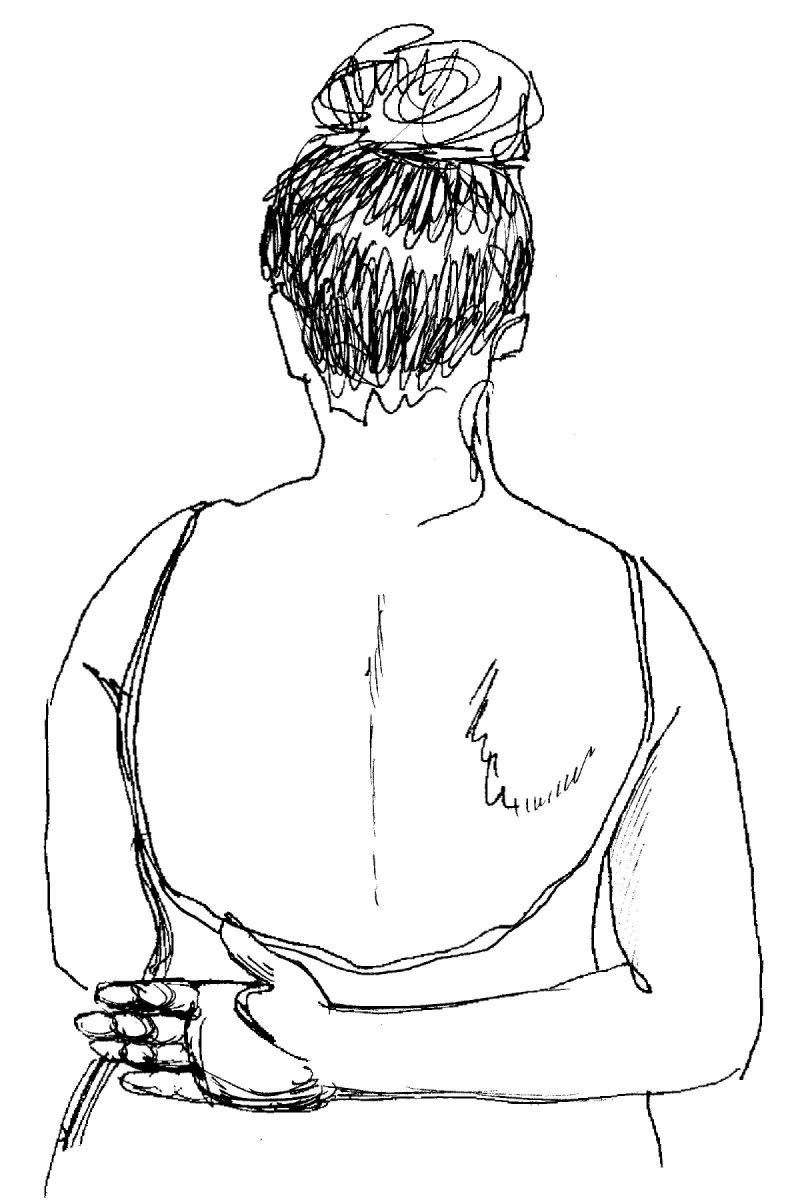
Backrub Test
Coracobrachialis Anterior Deltoid
SBAL
|
- Patient reaches across lower back to opposite side.
- Note distance achieved and difference between one side and the
other.
- Press at elbow, pushing arm downward and slightly to the rear
(away from the body).
A. No restriction: Knuckles of
palm extend beyond spine.
B. Restriction: Knuckles reach only
to midline. Restriction rare in persons of normal weight.
- Failure, or pain or weakness on resistance: severe restriction
in coracobrachialis, or a severely injured anterior deltoid; see
Arm Abduction Test.
- Unable to reach behind back: supinator; see Supinator
Test.
|
| Hand to
Shoulder Blade Test
Infraspinatus
DBAL Anterior Deltoid SBAL Supraspinatus Subscapularis
DBAL Supinator Pectoralis Major FF,
SFAL Latissimus Dorsi SFAL, BFL Teres Minor DBAL
 |
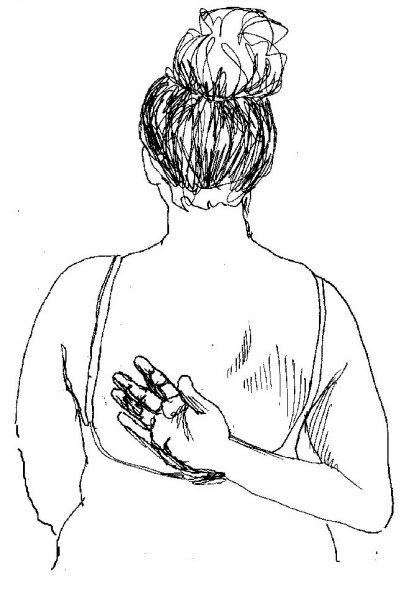
-
Patient reaches open hand behind back, wrist
straight.
-
Observe hand level relative to spine of scapula.
-
Measure any side-to-side variation.
Substitution: Bending wrist to reach higher up back.
A. No restriction: Fingertips reach spine of scapula.
B. Restriction: Fingertips cannot reach spine of scapula. If
patient:
- Can barely reach hip pocket: infraspinatus (primary) and
anterior deltoid (secondary). See Arm Abduction Test.
- Supraspinatus usually involved with infraspinatus (see Mouth
Wraparound Test) or upper trapezius (see Cervical Lateral Flexion Test).
- Is slightly restricted after treating infraspinatus: teres
minor.
- Can overcome shortening and weakness through passive motion
(such as walking fingers or wrist up back: subscapularis.
- Has restriction with pain in supinator reference area of
thumb; difficulty bending elbow to reach behind back. See
Supination Test.
- Still has restriction after working the above: pectoralis
major (see Shoulder Drop Test), latissimus dorsi (see
Overhead Reach Test).
|
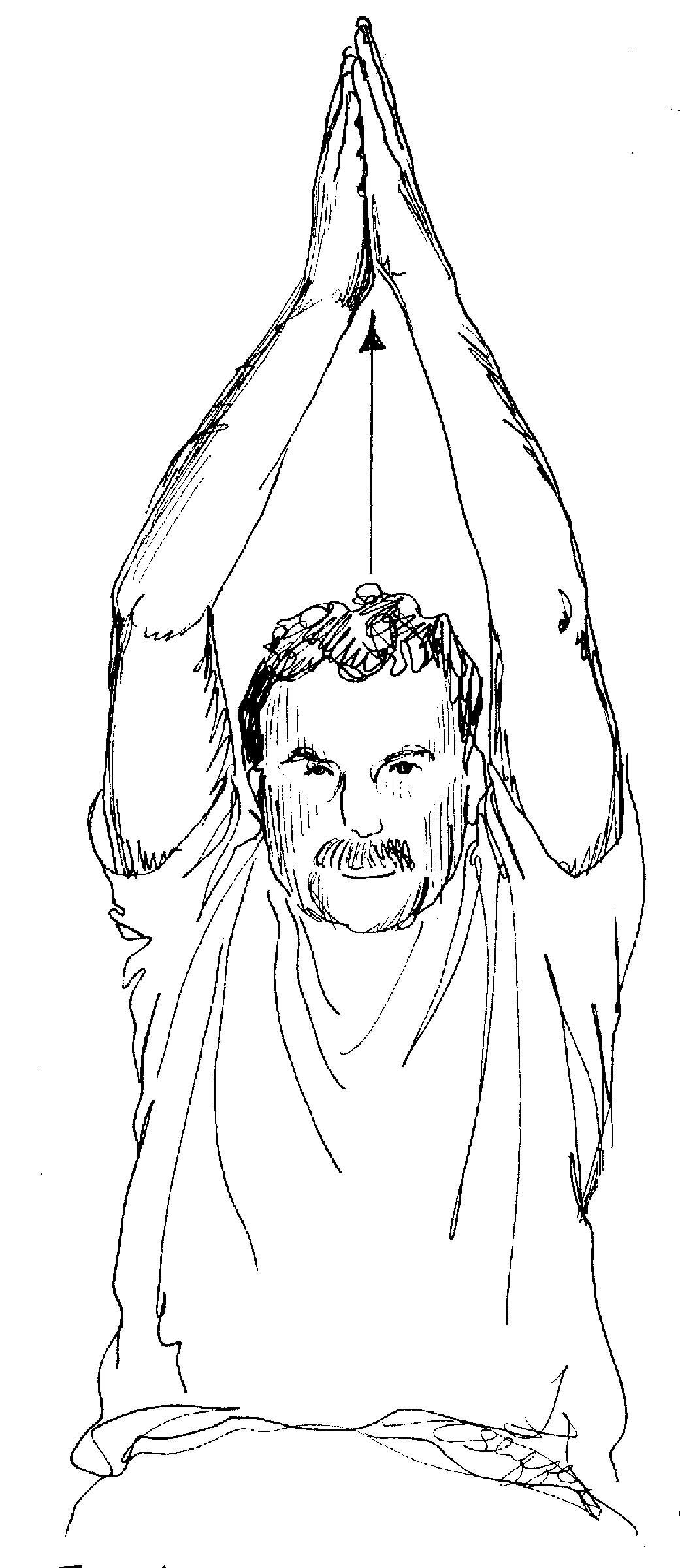
| Overhead Reach Test
Triceps DBAL
Teres Major SFAL
Latissimus Dorsi SFAL, BFL

|
-
Patient brings arms together
over top of head as if clapping
hands.
-
Determine whether patient can
bring arms in to touch ears, palms together, fingers
level.
Substitution: Tilting
arms away from short side to equalize
reach.
A. No restriction: Can
touch ears with insides of arms, arms reach same height, fingertips
aligned.
B. Restriction:
- With
severely shortened triceps or teres major, one arm or (or both)
will be bent, and it may be difficult or painful to
press arms to ears.
- If not possible to move arm
behind ears, teres major (see Mouthwrap Test),
coracobrachialis (see Backrub Test), and latissimus dorsi
may also be involved.
|
|
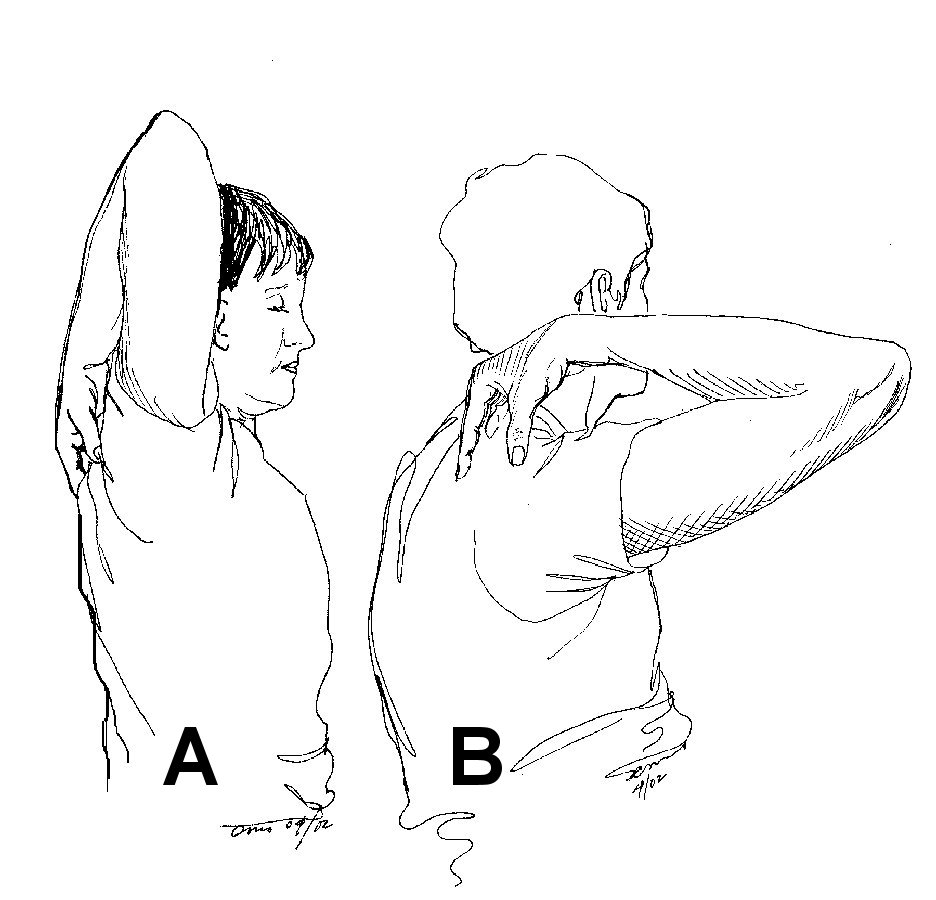
Over Shoulder Reach
Triceps DBAL

|
- Raise arm to shoulder level, arm out, palm up.
- Flex elbow to place palm on same-side shoulder, palm down.
- Slide palm down back, pointing elbow to
ceiling.
Substitution: Dropping head forward to bring ear forward of arm. Shifting
arm out to side to relieve tightness in triceps. Keep and elbow perpendicular
to body.
A. No restriction: Elbow vertical or beyond ear.
B. Restriction: Cannot point elbow to ceiling.
Note: The photo from which this sketch was made was not a staged shot. It was
actual Before & After range of motion. Compare active triceps trigger points
in B with improved range of motion immediately after treatment (A).
|
|
Copyright(c) 2005 Round
Earth Publishing. All rights reserved. |
|
www.round-earth.com
|
P. O. Box 10728 • Pittsburgh, PA 15203
• 412-381-4148 Toll-free Order
FAX:1-888-542-4543 • International FAX:
412-381-4060 | |